Solar Panels in 2026: The Price Is Right, But the Math Has Changed
Solar Panels in 2026: The Price Is Right, But the Math Has Changed
Published 2026-06-14 • Price-Quotes Research Lab Analysis

The Hardware Is Cheap. The Quote Is Not.
Somewhere in a neighborhood near you, a homeowner is staring at a solar installation quote and feeling a particular kind of modern whiplash. They have done the research. They know that solar panels have never been less expensive at the manufacturing level. They have seen the headlines about declining module costs, about oversupply in Chinese manufacturing, about efficiency gains that would have seemed like science fiction a decade ago. And yet the number on the page in front of them is still somewhere between $18,000 and $32,000.
This is the central paradox of residential solar in 2026, and it is the reason this article exists. The technology has never been better positioned to deliver long-term savings. The economics, however, have shifted in ways that every homeowner needs to understand before signing a contract.
The single most consequential change arrived quietly on December 31, 2025, when the federal Residential Clean Energy Credit the 30% tax credit that had made solar financially viable for millions of American homeowners expired as part of the One Big Beautiful Bill. On a $22,000 system, that credit was previously worth $6,600 in direct tax reduction. In 2026, it is gone. Solar.com's 2026 pricing analysis frames it plainly: homeowners and industry professionals alike are navigating a solar landscape that looks substantially different from the one that came before.
This article walks through what solar actually costs in 2026, where the money goes, what incentives remain available, and how to think through the buy-now alongside wait question based on real market data not marketing material.
What Solar Panels Actually Cost in 2026
The solar industry prices everything in dollars per watt because it normalizes across system sizes, panel wattages, and geographies. When an installer quotes $3.10 per watt, they mean the total installed cost panels, inverter, racking, wiring, labor, permits, and profit divided by the system's DC wattage.
In 2026, that number sits between $2.50 and $3.50 per watt for a fully installed residential system, with a median around $3.10/W. For a typical 8 kW residential system, that translates to $20,000-$28,000 before any incentives. Individual 410-watt panels run $130-$200 each when purchased without installation. TheGreenWatt's 2026 cost breakdown puts these numbers in context: the median installed cost is $3.10/W, but only $0.30-$0.70 of that is the panel itself. The rest is inverter, racking, labor, permits, and soft costs.
Most U.S. homeowners are looking at $18,000 to $32,000 for a solar-only system before any incentives, or $28,000 to $50,000+ when battery storage is included, according to EnergyScout's March 2026 market analysis. The national average for a complete solar installation falls around $19,000-$25,000 for a typical 6-8 kW home system. Larger homes or more complex installations push that number higher.
Here is how pricing breaks down across common system sizes, based on the $2.50-$3.50 per watt range:
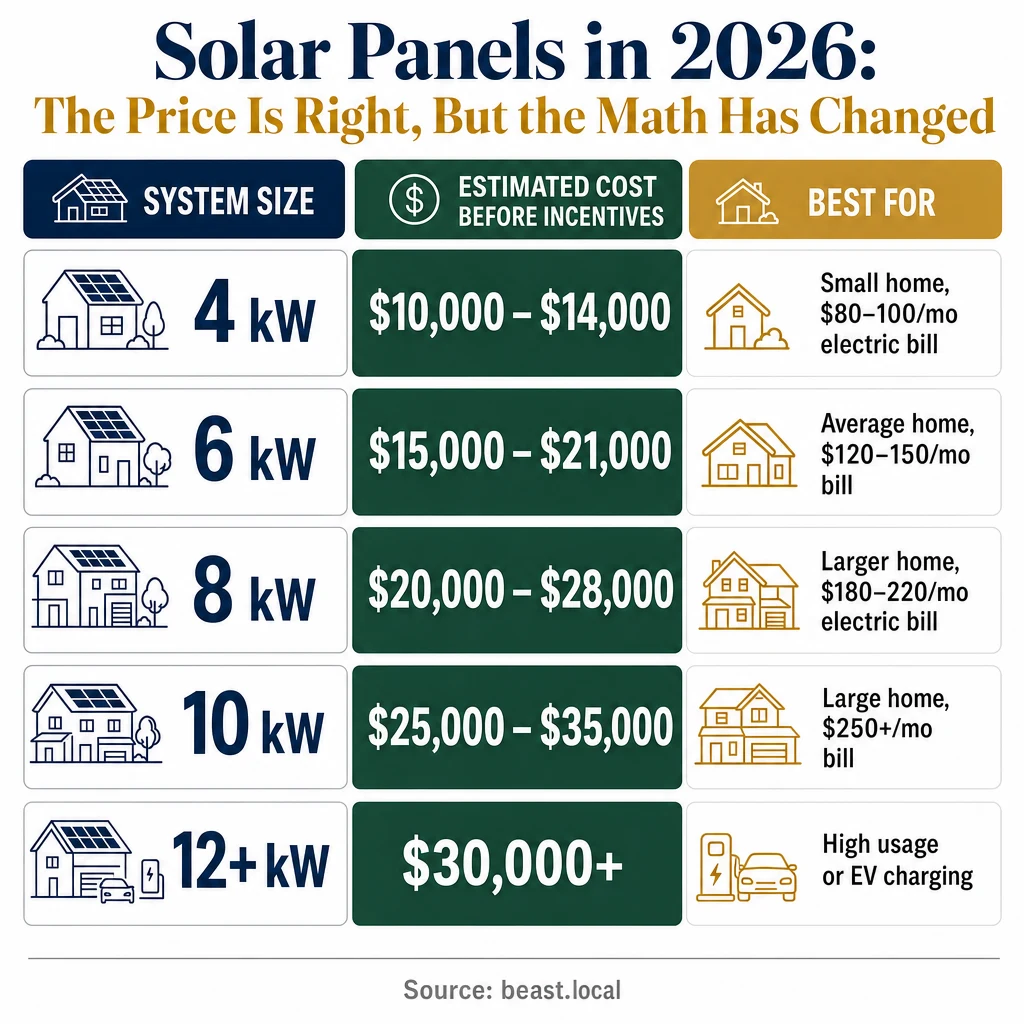
| System Size | Estimated Cost Before Incentives | Best For |
|---|---|---|
| 4 kW | $10,000 - $14,000 | Small home, $80-100/mo electric bill |
| 6 kW | $15,000 - $21,000 | Average home, $120-150/mo bill |
| 8 kW | $20,000 - $28,000 | Larger home, $180-220/mo bill |
| 10 kW | $25,000 - $35,000 | Large home, $250+/mo bill |
| 12+ kW | $30,000+ | High usage or EV charging |
These are national averages. Your actual number depends on system size relative to your electricity usage, roof design and shading, whether your electrical panel needs upgrading, local permitting and utility interconnection requirements, and significantly which installer you choose. Prices vary 20-30% between companies for the same system. Always get three or more quotes.
Where Your Money Actually Goes
This is the part that surprises most homeowners. They see news about cheap solar panels and expect their quotes to reflect that. The disconnect exists because the panel itself is a relatively small portion of what you pay.
Of the $2.50-$3.50 per watt for an installed residential system, only $0.30-$0.70 goes to the solar modules themselves. The inverter runs $0.25-$0.45 per watt. Racking and balance of system rails, clamps, wiring, conduit, combiner, disconnect adds $0.20-$0.35. Installation labor, with a two- to three-person crew working one to two days on electrical connections, runs $0.50-$1.00. Permits and design building permit, electrical permit, interconnection application, engineering stamp add $0.10-$0.20. Sales, overhead, and margin account for $0.40-$0.80.
Labor and soft costs together make up more than half the total. This is why a homeowner in Arizona might pay $15,000 for a 6 kW system while the same system in New York runs $19,000 not because the panels are different, but because labor rates, permitting overhead, and installer margins vary by region. TheGreenWatt's cost component analysis breaks this down in detail, showing that panels represent only 10-20% of total installed cost.
The Federal Tax Credit: What Changed and Why It Matters
For years, the federal Residential Clean Energy Credit commonly called the 30% solar tax credit was the financial centerpiece of any residential solar purchase. It was not a deduction. It was a dollar-for-dollar reduction on your tax bill. On a $24,000 system, that credit was worth $7,200. It applied to panels, labor, permits, and even battery storage. Unused credit rolled forward to future tax years.
That credit expired on December 31, 2025. If you purchase a solar system with cash or a loan in 2026, there is no federal tax credit applied to that purchase.
This is a meaningful change. On a typical 8 kW system priced at $24,800, the difference between 2024 and 2026 net cost after the credit alongside without it is approximately $7,000. EnergyScout's 2026 guide frames it this way: "On a $22,000 system, that credit was previously worth $6,600 in direct tax reduction." That $6,600 does not exist in 2026 for homeowners who buy outright.
What this means practically:
- Cash and loan purchases no longer receive a federal tax offset
- Leases and Power Purchase Agreements may still reflect incentive value the company that owns the system can capture available commercial credits and pass savings through lower monthly payments
- State and utility incentives have become the primary financial levers for homeowners who buy their systems outright
The commercial tax credit a separate 48E provision still applies to corporate-owned projects, including leases, PPAs, and prepaid solar products. This is why third-party ownership models remain competitive in 2026 even as the residential credit has disappeared.
What This Means for Solar Panel Costs in 2026 Readers
Here is the practical takeaway: the end of the federal tax credit does not mean solar is suddenly a bad investment. It means the math has changed, and the decision framework is different from what it was even a year ago. In 2024 and 2025, the federal credit was the gravitational center of any solar financial calculation. In 2026, it is not a factor at all for cash and loan buyers.
What has not changed is the underlying value proposition. If you are spending $150 per month on electricity, you are spending $1,800 per year and that number keeps climbing. Solar panels add approximately $4,000 in home value per kilowatt installed. Over a 25-year panel lifespan, the savings compound. The question is not whether solar makes financial sense in the abstract. The question is whether it makes sense for your specific home, your specific electricity usage, your specific roof, and your specific financing path in 2026.
The answer depends heavily on your state, your utility, your roof complexity, and which installer you choose. National averages are a starting point, not a quote. The only way to get an accurate number for your home is a site-specific assessment.
State and Local Incentives: The New Center of Gravity
With the federal credit gone, state and local incentives have moved from supporting role to lead. Depending on where you live, these incentives can offset 10-25% or more of your system cost. Some states have robust programs; others have very little.
States with established incentive programs include California, which has historically led in solar adoption and maintains utility rebates and state-level credits; New York, which offers NY-Sun incentives that can stack with utility rebates; Massachusetts, which has some of the most generous state-level incentives in the country; and New Jersey, which continues to build on its Solar Renewable Energy Certificate (SREC) program. Texas, by contrast, has minimal state-level solar incentives the market there is driven by electricity rate savings alone.
Utility rebates vary even within states. Some utilities offer $0.20-$0.50 per watt rebates for new solar installations. Others offer performance-based incentives that pay you based on the actual electricity your system produces. Net metering policies which determine how much credit you receive for excess electricity your system sends back to the grid vary dramatically by utility and state, and this has a significant impact on your long-term savings.
Property Assessed Clean Energy (PACE) financing is another option available in some states, allowing homeowners to finance solar installations through their property tax bills. This can be helpful for homeowners who lack the upfront capital to purchase a system outright but want to own more than lease.
Regional Price Variations: Why Your Zip Code Matters
Solar installation pricing is not uniform across the United States. A 6 kW system in Arizona might cost $15,000. The same system in New York could run $19,000 due to higher labor rates and permitting complexity. This is not because New York installers are charging more profit it is because the cost of doing business, the regulatory environment, and the local market dynamics are different.
Key factors that drive regional price variation:
- Labor costs: Electricians and solar installers in metropolitan areas with high costs of living command higher wages
- Permitting complexity: Some municipalities require extensive engineering reviews, multiple inspections, and lengthy interconnection applications; others have streamlined processes
- Utility interconnection requirements: Some utilities have backlogs for solar interconnection applications, adding weeks or months to project timelines
- Competition among installers: Markets with many active installers tend to have more competitive pricing; markets with few installers tend toward higher quotes
- Roof type prevalence: Regions with predominantly flat roofs, clay tile roofs, or complex rooflines add mounting complexity and cost
SolarCalc's 2026 cost guide notes that location matters significantly, with the same system size potentially costing thousands more depending on where you live. Their quarterly updates track these regional variations based on installer pricing and SEIA market reports.
To Buy or to Lease? Third-Party Ownership in 2026
For homeowners who prefer low upfront costs, leases and Power Purchase Agreements are a more prominent option in 2026 than they were in prior years. This is not because leases have gotten better it is because the alternative (buying without the federal credit) has gotten more expensive in relative terms.
Here is how they work: a third-party ownership company installs and owns the solar system on your roof. You pay a monthly lease payment or a per-kilowatt-hour rate for the electricity the system produces. Because the leasing company owns the system, it can claim the commercial tax credit (48E) and pass some of those savings through to you in the form of lower monthly payments than you would pay if you bought the system outright.
The trade-off is that you do not own the system, which means you do not capture the home value increase that comes with ownership. You also typically sign a 20-year agreement that can complicate a home sale. Some leases allow you to buy out the system or transfer the lease to the new homeowner; others do not.
Prepaid solar leases and PPAs represent a newer category in 2026, offering a middle path where you pay upfront for the right to own the energy the system produces over a set period. These products can still qualify for the federal commercial tax credit, making them attractive to homeowners who want some ownership-like economics without the full capital outlay of a purchased system.
Battery Storage: The Add-On That Changes the Equation
Adding battery storage to a solar installation for backup power, for time-of-use rate optimization, or for going off-grid adds $9,000 to $20,000 depending on battery size and any required electrical upgrades. A solar-plus-battery system runs $28,000 to $50,000+ before incentives.
Battery storage makes the most sense in areas with frequent grid outages, in states with unfavorable net metering policies where you earn less for excess solar electricity sent to the grid, or for homeowners who want to maximize self-consumption and reduce their reliance on the utility entirely. In states with favorable net metering and reliable grid infrastructure, the payback period for battery storage is longer.
Popular battery options in 2026 include the Enphase Battery, the FranklinWH, the Tesla Powerwall, and LG batteries. Each has different capacity, warranty, and integration characteristics. The right choice depends on your goals, your existing inverter system, and your budget.
Are Solar Panel Prices Expected to Go Down in the Future?
Hardware prices have followed a consistent downward trajectory for decades, driven by manufacturing scale, efficiency improvements, and global supply dynamics. Panel costs are lower today than they were five years ago, and lower than they were two years ago. This trend is likely to continue over the long term.
However, hardware is only one component of installed cost, and the labor, permitting, and soft-cost portions of the equation do not benefit from the same manufacturing scale dynamics. Installation labor costs have not declined and are unlikely to do so in a meaningful way. Permitting and interconnection costs are largely determined by local regulatory environments, not global markets.
The question of whether to wait is therefore not simply a question of whether hardware will get cheaper. It is a question of whether the incentive landscape will improve, whether your electricity costs will rise enough to make the investment more compelling, or whether your personal circumstances roof condition, home ownership timeline, electricity usage will change in ways that make solar more or less attractive.
For most homeowners, waiting for lower prices is a weaker strategy than optimizing for the right installer, the right financing structure, and the right system size for their specific situation.
How to Evaluate a Solar Quote in 2026
Given the complexity of the 2026 solar landscape, here is a practical framework for evaluating any solar proposal you receive:
1. Get three or more quotes. Prices vary 20-30% between companies for the same system. This is not because one company is lying it is because different companies have different labor costs, different supplier relationships, and different margin requirements. Three quotes gives you a market range.
2. Normalize quotes to dollars per watt. A 6 kW quote of $18,000 and a 7 kW quote of $20,000 are not directly comparable. Divide each total by the system size in watts to get a per-watt cost you can compare apples-to-apples.
3. Understand what is included. Some quotes include permitting and interconnection; others add those as change orders. Some include monitoring; others charge extra. Make sure each quote covers the same scope.
4. Ask about panel, inverter, and battery specifications. The quote should specify the panel model (LONGi, REC, Trina, Jinko, and others are common brands), the inverter type (string inverter alongside microinverters from Enphase or SolarEdge), and whether battery storage is included.
5. Understand your financing path. If you are considering a loan, understand the interest rate, the term, whether there are prepayment penalties, and how the loan interacts with any state incentives you may receive. If you are considering a lease or PPA, understand the monthly payment, the rate escalation clause, the contract term, and what happens at the end.
6. Verify state incentive eligibility. Before signing, confirm that the installer will help you apply for any state or utility incentives available in your area. Some incentives require specific paperwork, and missing a deadline can mean missing the incentive entirely.
Why This Matters
Residential solar in 2026 sits at an inflection point. The technology has matured. The hardware is reliable and efficient. The long-term economics based on avoided electricity costs over a 25-year panel lifespan remain compelling for many homeowners. But the financial architecture that made solar accessible to middle-income homeowners has been fundamentally restructured.
The federal tax credit that served as the primary financial incentive for residential solar purchases for more than a decade is gone. What remains are state incentives, utility rebates, net metering credits, and the long-term savings from generating your own electricity. For some homeowners, particularly those in states with robust incentive programs, solar remains an excellent investment in 2026. For others, particularly those in states with minimal incentives and high electricity costs, the math is tighter but still positive over time.
The homeowners who will get the best outcomes in 2026 are those who approach the decision with clear eyes who understand the real costs, the real incentives, and the real trade-offs, and who take the time to get multiple quotes from reputable installers. Solar is not a commodity. The right system for your neighbor's house may not be the right system for yours. The only way to know is to do the homework.
Where to Read Further
For homeowners ready to explore specific pricing for their zip code, Solar.com's 2026 solar pricing analysis provides a detailed look at how policy changes are affecting installation costs and what homeowners need to know entering 2026. TheGreenWatt's cost guide offers a component-by-component breakdown of where your installation dollar goes. EnergyScout's 2026 solar cost overview walks through the financial landscape for homeowners navigating the post-credit era. SolarCalc's cost guide provides quarterly updated regional pricing data and system size cost estimates.