Solar Panel ROI Calculator: When Do Panels Actually Pay for Themselves in 2026
Solar Panel ROI Calculator: When Do Panels Actually Pay for Themselves in 2026
Published 2026-04-10 • Price-Quotes Research Lab Analysis
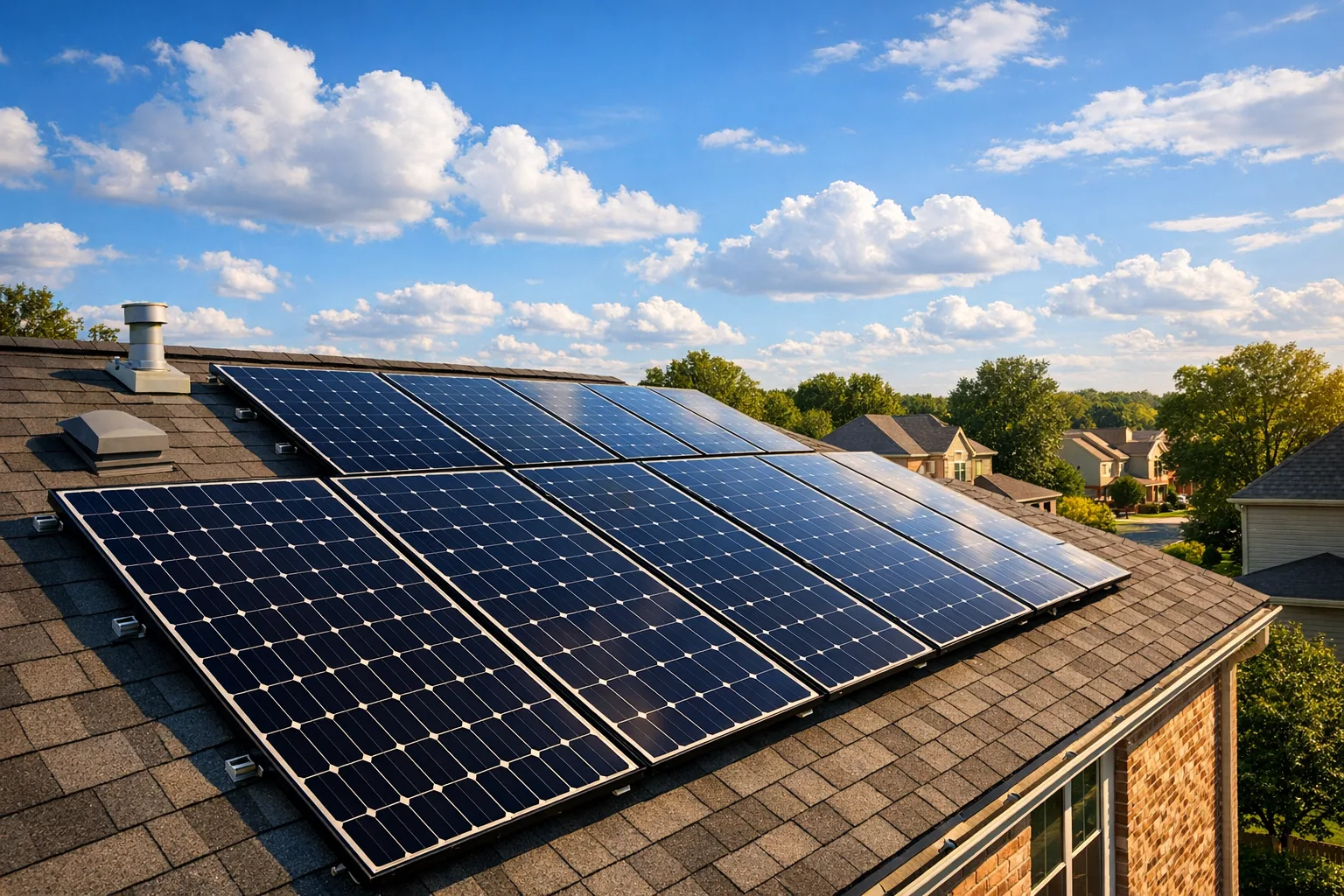
The 30% Federal Solar Tax Credit Is Gone — And Your Payback Math Just Changed Forever
Here's the number that should dominate every solar conversation in 2026: the 30% federal Investment Tax Credit (Section 25D) that homeowners relied on for years expired on December 31, 2025. If you didn't have your system placed in service by that date, you don't get it. Period. This single fact rewrites the entire return-on-investment equation for residential solar — and most homeowners don't even know it happened.
According to CleanEnergyCalc's 2026 Solar Payback Period Calculator, the typical residential system costs $2,800 to $3,200 per kilowatt before any incentives. For a standard 6-kilowatt system — roughly the size most American homes need — that's $16,800 to $19,200 in upfront equipment and installation costs. In 2025, a homeowner who locked in that system would have subtracted $5,040 to $5,760 from their tax bill, landing at a net cost of roughly $11,000 to $13,500. In 2026, that same homeowner pays the full sticker price unless state or local programs ride to the rescue.
That distinction — the difference between $11,000 and $19,200 — is why this article exists. Price-Quotes Research Lab built this guide to give you an honest, number-crunched answer to the only question that actually matters: when do your solar panels generate more in savings than they cost? Most people hear "solar calculator" and imagine a toy that spits out a number. That's not what we're describing. A real solar ROI calculator — the kind SolarProGuide publishes, for instance — processes five to seven input variables to generate a 25-year financial model. Here's what it actually needs from you: Monthly electricity usage in kilowatt-hours (kWh). Find this on your utility bill. It's the single most important input. A home in Phoenix running air conditioning 8 months a year uses vastly different power than a Seattle household with mild summers. The calculator converts this into your system's required size. Your local utility rate structure. Electricity costs vary dramatically. The national average residential rate sits around $0.14 per kWh, but residents in California, Hawaii, New York, or Massachusetts pay $0.25 to $0.45 per kWh. Those higher rates compress payback timelines because every kilowatt-hour you offset with solar is worth more money. Your solar irradiance or sun hours. A 6-kW system in the Nevada desert produces roughly 30% more electricity annually than the same system in cloudy Portland. The Solantiq cost analysis shows that regional irradiance data from NREL's solar resource databases directly multiplies — or divides — your annual savings. System cost and financing method. This is where 2026 gets complicated. Cash purchase, solar loan, and lease/PPA structures each produce dramatically different outcomes on the same physical system. We break each down below. Available incentives. Federal credit is off the table for 2026 homeowners, but state programs, utility rebates, SRECs (Solar Renewable Energy Credits), and property tax exemptions still exist in many markets. The DSIRE database remains the authoritative source for tracking what's still live in your state. Buying your solar system outright with cash delivers the best long-term ROI. No interest payments. No financing fees. You own the asset, and every kilowatt-hour your panels produce is money in your pocket. A 10-kilowatt system in 2026 costs approximately $28,000 before incentives (based on Grid Modernist's 2026 analysis). Without the 30% federal credit, your net cost is $28,000. Assuming you pay $0.28 per kWh and your system generates 14,000 kWh annually (a reasonable estimate for most of the southern half of the United States), you save $3,920 per year on your electricity bill. At that rate, your payback period is just over 7 years. Over 25 years, you pocket roughly $70,000 after accounting for minor maintenance costs and inverter replacements around year 12. That's a 150% return on your initial investment. But the math tightens in lower-rate markets. If you pay $0.14 per kWh and generate 10,000 kWh annually (more realistic for the Pacific Northwest or Upper Midwest), you save $1,400 per year. Your payback stretches to 20 years — and after 25 years, you're barely ahead once you factor in degradation and repair costs. In those markets, solar without heavy incentives is a marginal proposition in 2026. Most homeowners don't write $28,000 checks. They finance. And financing changes everything about your tax situation. Here's the counterintuitive part that trips up even financially sophisticated buyers: you cannot claim the federal ITC on a system purchased with a loan in 2026 because the credit itself no longer exists for residential systems. In prior years, you'd have claimed the 30% credit against your tax liability, then used savings to pay down the loan. That arbitrage strategy is dead for 2026. Solar loans in 2026 typically carry interest rates between 5.99% and 9.99% APR, depending on credit score and loan term (10 to 25 years). A $28,000 loan at 7.5% over 20 years costs approximately $40,800 total. Your annual electricity savings of $2,000 to $3,500 cover the loan payments — usually — but your total cost over 20 years exceeds what you'd have paid the utility. You're betting that electricity rates will rise enough over two decades to make up the difference. That bet is historically sound. The U.S. Energy Information Administration has projected average retail electricity rate increases of 2% to 4% annually through 2030. Over 20 years, that compounds into rates of $0.23 to $0.35 per kWh in many markets. At those rates, a solar loan that looked tight in year one becomes genuinely profitable by year 12. Solar leases and PPAs let you install panels with zero money down. You pay a fixed monthly lease payment (lease) or a per-kilowatt-hour rate for the electricity the system produces (PPA). Third-party-owned systems retain eligibility for the Section 48E Clean Electricity Investment Tax Credit through December 31, 2027 — a critical distinction that keeps installer pricing competitive, even if you personally don't claim a credit. The upside: no upfront capital. No maintenance liability. The lease company handles repairs. The downside: you never own the system. Your electricity savings are capped at whatever your lease payment would have been, and you typically sign 20- to 25-year agreements with escalating annual rates (usually 0% to 3% escalator clauses). When you sell your home, you either transfer the lease (not always easy) or buy out the remaining contract value. For homeowners in high-electricity-cost states — California, Massachusetts, New York — a well-negotiated PPA can still make financial sense. A $0.18 per kWh PPA rate when your utility charges $0.35 per kWh locks in 49% savings from day one. But the SolarROICheck calculator shows that in low-rate markets (the Midwest, Southeast, Texas), a lease or PPA often costs more over 20 years than simply staying on the grid. Geographic variance is not a side note. It is the entire story. The Energy Rebate Calculator's state-by-state analysis demonstrates payback periods ranging from under 6 years in favorable markets to over 18 years in unfavorable ones — all within the same calendar year, all for comparable system sizes. Fastest payback (under 7 years): Hawaii, California, Massachusetts, New Jersey, New York. These states share high electricity rates ($0.30 to $0.45 per kWh), strong net metering policies, and in some cases, state-level incentive stacks. Hawaii's combination of 30% federal credit plus 5% state credit and high utility rates historically delivered payback in 4 to 6 years. With the federal credit gone, expect 6 to 8 years — still excellent. Moderate payback (8 to 12 years): Colorado, Arizona, Nevada, Maryland, Connecticut. Decent sun exposure, moderately high rates, and some state rebates. Without the federal credit, these markets require more careful analysis. A Colorado homeowner paying $0.14 per kWh and getting 300+ sunny days annually still recovers their investment within a decade, assuming electricity rates continue their upward trend. Slower payback (13 to 20+ years): Pacific Northwest, Upper Midwest, Northern Great Plains. Low electricity rates ($0.10 to $0.13 per kWh), inconsistent irradiance, and fewer state incentives create genuine headwinds. In these markets, solar makes the most sense for homeowners with high annual consumption (electric vehicles, heat pumps, swimming pools) or those who value energy independence over pure financial return. Price-Quotes Research Lab recommends these buyers run multiple scenarios — including a scenario where electricity rates stay flat — before committing. Solar panels degrade. This is not a defect — it's physics. The industry standard degradation rate is 0.5% to 0.8% per year, meaning your system produces 80% to 88% of its original output after 25 years. Some premium panel manufacturers (Panasonic, REC, Maxeon) advertise degradation rates as low as 0.25% annually, which meaningfully extends your effective payback period. Cheaper panels from lesser-known manufacturers can degrade at 1% to 1.5% annually. Over 20 years, a system that's lost 20% of its capacity is generating $400 less per year in a market where you originally projected $2,000 in annual savings. That $400 difference extends your actual payback by 2 to 4 years beyond what the calculator projected. Always check the manufacturer's 25-year performance warranty before purchasing. The warranty language matters. Some warranties guarantee 90% output at year 25; others guarantee only 80%. That 10% difference represents thousands of dollars over the system's lifetime. Net metering policies determine how much value you get from every kilowatt-hour your panels produce. When your system generates more electricity than your home consumes (common on sunny spring and fall afternoons), the excess flows back to the grid. Your utility credits you at the retail electricity rate under a full net metering policy — essentially, you earn full price for your surplus power. But 38 states have modified their net metering policies since 2020, according to the National Renewable Energy Laboratory's annual solar policy review. Many now use "value-of-solar" rates, "buy-all-sell-all" models, or capacity-based compensation that pays significantly less than retail rates. California, for instance, moved from true net metering (NEM 1.0) to NEM 2.0 and is now transitioning to NEM 3.0, which reduces compensation for exported solar by 50% to 75% in many utility territories. If your state has weakened net metering rules, your payback period lengthens. A system in California that looked like a 7-year payback under NEM 2.0 may perform like a 10-year payback under NEM 3.0. Run your solar payback calculator using your utility's current export compensation rate — not the retail rate — for an honest picture. Open any free solar calculator and you'll see input fields. Here's how to use them properly in 2026. Step 1: Enter your actual 12-month electricity usage. Don't estimate. Pull 12 consecutive months of bills from your utility account. Solar companies will sometimes use a monthly average that flatters their projections. You want your real consumption, including seasonal spikes. Step 2: Input your current utility rate, not an estimate. Look at the "rate per kWh" on your bill. Enter this exactly. If your utility uses tiered pricing (cheaper rates for the first 500 kWh, more expensive rates for higher consumption), your effective rate is the blended average across all tiers. Step 3: Set the incentive inputs correctly. For 2026 installations, federal credit = 0%. If your state has a program, enter the specific percentage (e.g., 10% for New York's state credit, capped at $5,000). Do not assume incentives exist unless you've confirmed them on DSIRE or directly with your state energy office. Step 4: Run three payback scenarios. First, assume flat electricity rates. This is your worst-case baseline. Second, assume 2.5% annual rate escalation — the historical average. Third, assume 4% annual escalation. The spread between your worst-case and best-case payback tells you your risk exposure. Price-Quotes Research Lab recommends proceeding only if your worst-case payback falls within your planned homeownership horizon. Step 5: Get three installer quotes. No calculator replaces actual bids from real contractors. The EnergySage Q4 2025 benchmark of $2.85 per watt (gross installed) gives you a baseline, but pricing varies by $0.50 to $1.00 per watt between installers in the same market. That $0.75 per watt difference on a 10-kW system is $7,500 — more than enough to shift a payback period by 2 years. After processing all variables — without the federal credit, with current installed costs, and with realistic electricity rate escalation — the honest answer from Price-Quotes Research Lab's analysis looks like this: The 2026 solar ROI calculation becomes dramatically more attractive if electricity prices accelerate. A 6% annual rate increase — plausible if natural gas prices surge, if coal plants retire faster than expected, or if grid infrastructure costs get passed to consumers — would compress payback periods by 2 to 4 years in most markets. The Sustainable Atlas ROI analysis for 2026 modeled a scenario where residential rates reach $0.35 per kWh nationally by 2035. In that environment, even the Pacific Northwest — historically a tough solar market — would see payback periods fall below 10 years. A homeowner who installs in 2026 at $0.14 per kWh and watches their rate climb to $0.31 per kWh by 2033 is effectively locking in decades of savings at a rate they never thought they'd see. Pairing solar panels with battery storage (typically a Tesla Powerwall 3, Franklin WH, or similar 13.5-kWh home battery) adds $10,000 to $15,000 in upfront costs. In markets with time-of-use (TOU) pricing — where electricity costs $0.40 per kWh during peak evening hours but $0.08 per kWh during midday solar production hours — battery storage dramatically increases the value of your solar generation. A California homeowner with TOU pricing and a battery can consume their solar generation during the expensive evening hours instead of exporting it during cheap midday hours. The Renewable Energy Calculator's 2026 battery storage analysis shows this strategy can add $800 to $1,400 in annual value, effectively paying for the battery's added cost within 8 to 12 years. With California's NEM 3.0 reducing export values, battery storage shifts from optional to essential for maximizing solar ROI in that state. Yes — but the answer is geographically fractured in ways it wasn't in 2024 or 2025. The expiration of the 30% federal ITC is not a headline that affects everyone equally. Homeowners in California, Hawaii, New York, and Massachusetts who face electricity rates above $0.30 per kWh can still achieve payback in under a decade, even without the federal credit. The state incentives, high utility rates, and net metering policies in these markets create compelling economics. For homeowners in low-rate markets who were counting on the federal credit to make the numbers work — the math is harder now. A payback period that was 7 years with the credit is now 10 to 12 years without it. That's not necessarily a dealbreaker, but it demands scrutiny. Price-Quotes Research Lab recommends running your specific numbers through multiple solar payback calculators, getting three competing bids, and verifying every incentive on DSIRE before signing anything. Solar remains one of the few home improvements that pays for itself. The 30% credit expiration narrowed the margin of safety, but it didn't eliminate the margin entirely. The panels got cheaper. The panels got more efficient. And electricity rates are not going down. Use the tools. Run the numbers. And don't let anyone sell you a system without showing you the full 25-year financial model with and without state incentives, with flat rates and escalating rates, and with three different installer bids side by side. That's not being difficult — that's being a smart homeowner in a market that's still learning to price honestly.What a Solar Panel ROI Calculator Actually Measures
The Three Financing Scenarios: Cash, Loan, and Lease
Scenario 1: Cash Purchase — Cleanest Math, Highest Upfront
Scenario 2: Solar Loan — The Middle Path With Tax Implications
Scenario 3: Lease or Power Purchase Agreement (PPA) — Low Barrier, Capped Upside
2026 State-by-State Payback Reality
The Degradation Problem Nobody Talks About
Net Metering: Your Secret Weapon or Hidden Trap?
How to Use a Solar ROI Calculator Correctly
The Real Break-Even Timeline for 2026
What Changes If Electricity Rates Spike Faster Than Expected
The Battery Storage Wild Card
The Bottom Line: Is Solar Worth It in 2026?
Key Questions
Is the 30% federal solar tax credit available in 2026?
How long does it take for solar panels to pay for themselves in 2026?
What is the average cost of a solar panel system in 2026?
What is the best free solar ROI calculator for 2026?
Do solar leases and PPAs still make sense without the federal credit?
How do I verify which state solar incentives are still available?
Related Services