Solar in 2026: What Homeowners Actually Pay, Save, and Need to Know Before Signing
Solar in 2026: What Homeowners Actually Pay, Save, and Need to Know Before Signing
Published 2026-06-14 • Price-Quotes Research Lab Analysis
The Number on the Table
Before any homeowner in Cheyenne, Wyoming signs a contract for a 6 kW solar array, they will do the same math that thousands of Americans are running right now: what does this cost, what do I save, and when does it pencil out? The answers have shifted in 2026. The federal Investment Tax Credit that once knocked 30 percent off a residential solar installation ended on December 31, 2025, and that single change rewrites the economics of going solar for every homeowner who did not act before the calendar turned. Understanding exactly what 2026 pricing looks like and where the real value still lives is the purpose of this guide.
The numbers are concrete. According to SolarReviews' June 2026 analysis, a 7.2 kW residential solar system costs an average of $21,816 before incentives, or approximately $3.03 per watt of installed capacity. That figure represents the full installed cost: panels, inverter, racking, wiring, labor, permits, and installer margin. For context, a 10 kW system runs closer to $28,600 before credits. These are not speculative projections they are compiled from data collected by the National Renewable Energy Laboratory, the U.S. Energy Information Administration, and the Bureau of Labor Statistics.
But the story does not end at the price tag. The story is about what that price tag means over ten, twenty, and twenty-five years of ownership.
What $3.03 per Watt Actually Buys
One of the most useful frameworks in solar pricing is the cost-per-watt metric, because it normalizes across system sizes, panel wattages, and geographies. When an installer quotes $3.10 per watt, they mean the total installed cost divided by the system's DC wattage everything from the contract signing to the final electrical inspection.
TheGreenWatt breaks down where that dollar goes in its 2026 pricing guide. Of the $2.50 to $3.50 per watt homeowners pay for an installed residential system, only $0.30 to $0.70 is the panel itself. The inverter accounts for $0.25 to $0.45 per watt. Racking and balance-of-system components rails, clamps, wiring, conduit, combiner, disconnect run $0.20 to $0.35. Installation labor, handled by a two- to three-person crew over one to two days, adds $0.50 to $1.00 per watt. Permits and design work building permit, electrical permit, interconnection application, engineering stamp add $0.10 to $0.20. Sales, overhead, and installer margin together account for $0.40 to $0.80 per watt.
That breakdown matters because it explains why solar is not simply a hardware purchase. Labor and soft costs together make up more than half the total installed price. A homeowner comparing two bids should understand that a lower price per watt may reflect a leaner installation crew, fewer engineering reviews, or a less comprehensive warranty not necessarily better panels.
"Of the $3.10/W median installed cost, only $0.30-$0.70 is the panel itself; the rest is inverter, racking, labor, permits, and soft costs." TheGreenWatt, 2026 Pricing Guide
The Federal Credit That Closed
For several years, the federal Residential Clean Energy Credit commonly known as the solar Investment Tax Credit, or ITC offered 30 percent off the cost of a qualifying solar installation under Section 25D of the tax code. For a homeowner who installed a 7.2 kW system in 2024, that credit translated to roughly $6,544 off the total price, bringing the net cost down to approximately $15,271.
The credit was available through the end of 2025. As of June 2026, it is no longer an active federal incentive for new residential installations. This is not a future deadline or a program at risk it is a historical fact. Homeowners who installed in 2024 or 2025 captured that credit. Those purchasing in 2026 do not.
The practical effect is significant. TheGreenWatt estimates that the absence of the federal credit adds approximately $7,000 to the net cost for a 2026 buyer compared to a 2024 buyer. That is not a small number, and it changes the payback math. However, it does not eliminate the value proposition it shifts the argument from "the government is subsidizing your switch" to "the economics still work because your electricity bills are rising."
State-level incentives vary. Wyoming, which has no state income tax, relies primarily on federal incentives and with the federal credit closed, Wyoming homeowners are now operating in a thinner incentive environment than they were in 2024 or 2025. Other states offer programs that partially fill the gap. TheGreenWatt notes that state incentives can range from $0 to $8,000 depending on location, and homeowners should verify what their state offers in 2026 before assuming the economics are the same as they were two years ago.
Regional Variation: Cheyenne as a Case Study
Solar panel costs are not uniform across the country. Regional differences in labor rates, permitting complexity, and local market competition create meaningful price variation from state to state and city to city. Cheyenne, Wyoming offers a useful case study because it sits in a state with relatively low electricity rates, no state income tax, and a climate that includes both strong sun hours and cold winters that affect system performance.
According to SmartEnergyUSA's 2026 Cheyenne guide, the average cost of solar panels in the city is approximately $2.95 per watt before incentives. For a typical 6 kW residential system, that means a total cost of about $17,700 before any credits. After applying the 30 percent federal ITC which was available through 2025 the net cost dropped to approximately $12,390. For 2026 buyers, that credit is no longer available, meaning the net cost for the same 6 kW system in Cheyenne is now approximately $17,700.
Cheyenne homeowners who installed in 2025 or earlier also benefited from net metering, which credits them at the retail rate for excess electricity sent back to the grid. Wyoming requires utilities to offer net metering for residential solar systems up to 25 kW, with excess generation credited at the retail rate. This remains an active policy as of June 2026.
The property tax exemption for residential renewable energy systems is also still active in Wyoming. The value of the solar system is exempted from property tax calculations, which matters in a state where property taxes are calculated on assessed value. A homeowner who installs a $17,700 system does not see their property tax bill rise as a result.
Cheyenne's payback period for a 6 kW system is approximately 10 years, with estimated 25-year savings of around $24,000 according to SmartEnergyUSA's 2026 data. Those figures assume the federal ITC was applied without it, the payback period extends by roughly three to four years, depending on electricity rates and system production.
How Long Does It Take to Break Even?
The payback period is the question most homeowners actually want answered: how many years before the savings from lower electricity bills equal the cost of the system? The answer depends on system size, local electricity rates, available sunlight, and whether incentives were applied.
For a 6 kW system in Cheyenne at $17,700 with no federal credit in 2026, the payback period is approximately 10 to 11 years based on current utility rates and production estimates. For a 7.2 kW system nationally at $21,816 with no federal credit, the payback period falls in a similar range roughly 10 to 12 years depending on the homeowner's local electricity rate and how much of their usage the system covers.
EcoWatch's 2025 Cheyenne data, which remains the most detailed local breakdown available, shows a 10.3-year payback period for the average Cheyenne homeowner and 25-year savings of approximately $63,644. Those savings figures were calculated with the federal ITC applied. In 2026, without the credit, the 25-year savings figure would be lower but the core math remains favorable for homeowners with stable or rising electricity rates.
It is worth noting that electricity rates have been rising at what Solar.com describes as "a rapid pace" in its 2026 guide. When utility rates go up, the value of solar-produced electricity increases proportionally, which compresses payback periods over time. A system installed in 2026 that costs more upfront may deliver better savings per year than a system installed in 2024, simply because utility rates are higher.
What About Home Value?
Beyond the monthly bill savings, solar panels have a documented effect on property value. TheGreenWatt cites a general industry estimate of approximately $4,000 per kilowatt of installed capacity added to home value. For an 8 kW system, that translates to roughly $32,000 in added equity a figure that reflects both the energy cost savings the system provides and the premium buyers increasingly place on energy-independent homes.
Solar.com's 2026 guide lists "Increase Your Home Property Value" as one of the primary benefits of going solar, alongside lower electric bills and energy independence. The platform's analysts note that homes with solar installations tend to sell faster and at higher prices in markets where buyers are familiar with solar technology.
This matters for the overall investment calculus. A homeowner who installs an 8 kW system for $24,800 in 2026, pays it off over 10 to 12 years through electricity savings, and then sells the home 15 years later may recover a meaningful portion of the original cost through increased sale price. The investment is not just in energy it is in an asset that appreciates in a rising-rate environment.
Are Solar Panels Worth It in 2026?
The question is fair, and the answer depends on what problem the homeowner is trying to solve. Solar panels are not a get-rich-quick scheme. They are a long-term energy strategy that requires a 10- to 12-year horizon to fully recoup the investment. For a homeowner who plans to stay in the house for 15 to 20 years, the economics are strong. For a homeowner who plans to sell in three years, the upfront cost without the federal credit may not be the right move.
SolarReviews' June 2026 analysis frames it directly: "While that price tag seems steep, the electricity bill savings you get from solar panels make them a worthwhile investment for most Americans." The publication's team analyzed data from the National Renewable Energy Laboratory, the U.S. Energy Information Administration, and the Bureau of Labor Statistics to arrive at that conclusion, and the core logic holds in 2026 even without the federal credit because electricity rates continue to rise.
The value proposition is strongest in states with high electricity rates, strong net metering policies, and favorable property tax treatment. It is weakest in states with low electricity rates, limited net metering, and no state-level incentives. A homeowner in Hawaii, where electricity rates are among the highest in the country, will see a much faster payback than a homeowner in a state with subsidized utility rates.
What This Means for Solar Panel Costs Readers
If you are researching solar panel costs because you are considering an installation, the most important thing to understand is that the 2026 landscape is different from 2024 and 2025 in one critical way: the federal 30 percent Investment Tax Credit is no longer available. This changes the upfront math significantly by roughly $7,000 for a typical residential system and homeowners who are comparing 2024 or 2025 case studies should factor that difference in.
However, the core economics still work. Electricity rates are rising. Net metering remains active in many states. Property tax exemptions for solar systems are still on the books in states like Wyoming. And home value increases from solar installations are a documented benefit that partially offsets the upfront cost over time. The question is not whether solar makes financial sense in the abstract it is whether it makes sense for your specific house, your specific electricity usage, your specific utility rate, and your specific timeline for staying in the home.
System Size and What It Covers
One of the most common mistakes homeowners make when pricing solar is underestimating the system size they need. A 4 kW system covers a modest portion of a typical American home's electricity usage. A 10 kW system is designed for a larger home with higher consumption, electric vehicles, or electric heating.
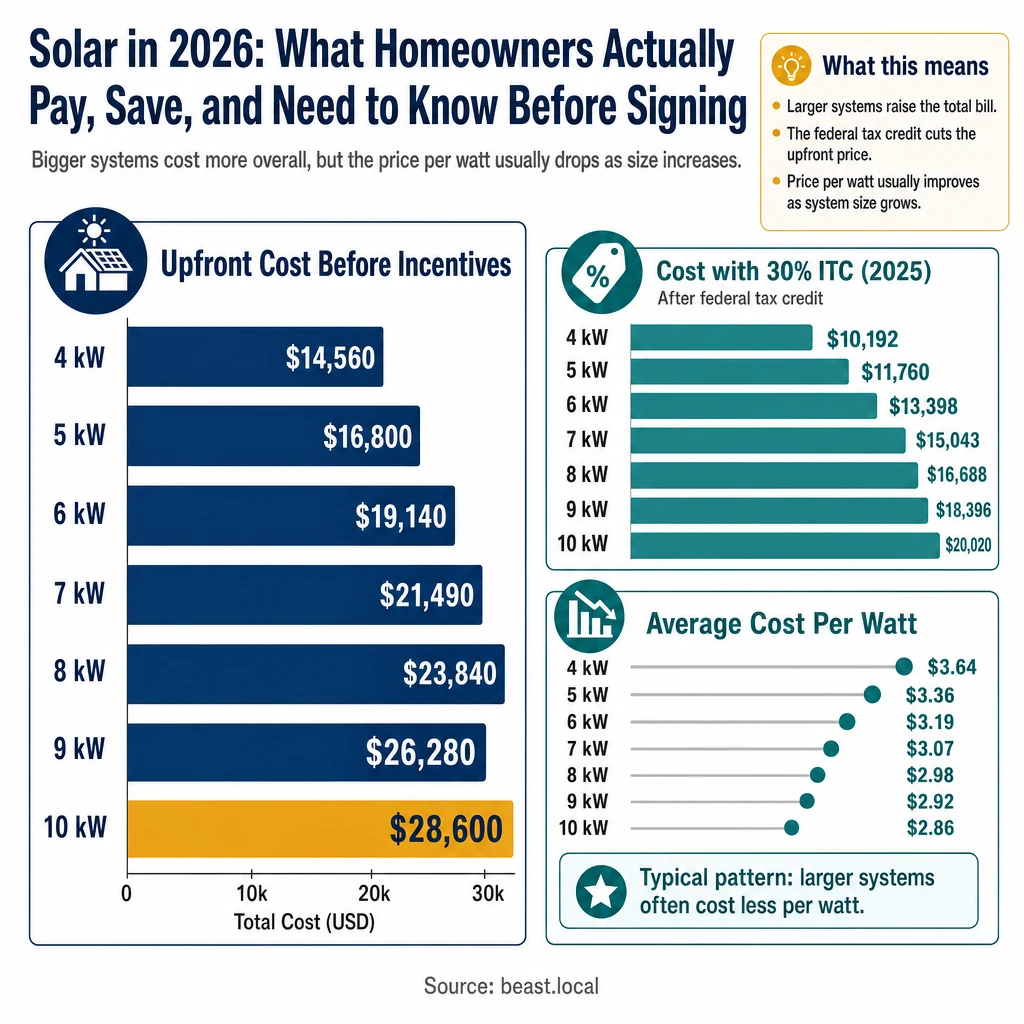
SolarReviews' 2026 data provides a clear cost breakdown by system size:
| System Size | Total Cost (Before Incentives) | Cost with 30% ITC (2025) | Cost Per Watt |
|---|---|---|---|
| 4 kW | $14,560 | $10,192 | $3.64 |
| 5 kW | $16,800 | $11,760 | $3.36 |
| 6 kW | $19,140 | $13,398 | $3.19 |
| 7 kW | $21,490 | $15,043 | $3.07 |
| 8 kW | $23,840 | $16,688 | $2.98 |
| 9 kW | $26,280 | $18,396 | $2.92 |
| 10 kW | $28,600 | $20,020 | $2.86 |
Note that the cost per watt decreases as system size increases a consistent pattern across the industry. A 4 kW system costs $3.64 per watt, while a 10 kW system costs $2.86 per watt. This is partly because certain fixed costs permits, design work, interconnection application are spread across more watts of capacity as the system grows.
For 2026 buyers without the federal credit, these pre-incentive prices are the relevant starting point. The ITC column in the table above reflects 2025 pricing with the credit applied and is included for reference only.
Financing and the Hidden Cost of Loans
Not every homeowner has $20,000 to $28,000 in cash sitting in a bank account. Solar financing through solar-specific loans, home equity loans, or personal loans is a common path. But financing changes the math.
SolarReviews notes that when homeowners finance solar panels using a loan, the average cost per watt is closer to $3.62 per watt installed. Solar-specific loans typically include dealer fees that add an average of 19.99 percent to the principal of the loan. By the end of a typical 20-year loan with 5.99 percent interest, a homeowner will pay approximately $31,273 in loan payments for a 7.2 kW system compared to $21,816 for a cash purchase of the same system.
That premium is worth understanding before signing. A loan that spreads the cost over 20 years makes the monthly payment manageable, but the total interest and fees paid over the life of the loan can add thousands of dollars to the effective cost of the system. Homeowners who can access a home equity line of credit at a lower interest rate may find a better financing path than a solar-specific dealer loan.
Where to Read Further
For homeowners ready to get specific pricing for their zip code, SolarReviews' solar panel cost calculator provides location-specific estimates based on current market data from the National Renewable Energy Laboratory and the U.S. Energy Information Administration. The platform covers all 50 states and Puerto Rico, making it one of the most comprehensive publicly available pricing tools.
For a detailed breakdown of cost components where every dollar of the per-watt price goes TheGreenWatt's 2026 pricing guide is the most granular source in this analysis. The site's founder documents building a personal 6 kW system in Slovenia, providing a useful international comparison point for understanding why U.S. installation costs run higher than European equivalents.
For state-specific incentive details and net metering policy, SmartEnergyUSA's Cheyenne guide offers a clear breakdown of federal, state, and local programs available in Wyoming, including the property tax exemption and net metering requirements that remain active in 2026.